
Survey first: $300–$750
A recorded camera run with distances marked. Yours to keep, and usually credited if the work goes ahead.
A cracked or root-damaged drain does not have to mean a trench through the garden. A resin liner is cured inside the existing pipe from an access point you already have, sealing every joint along the run, and the surface above is never touched.
A resin-saturated liner is drawn into the existing pipe through an access point, inflated so it presses against the wall, and cured until it hardens. What you are left with is a continuous pipe inside the old one, with no joints along its length and a slightly smaller bore than the original.
Nothing is excavated, and the cured surface is smoother than the clay or concrete it lines, so flow is typically maintained or improved despite the small loss of diameter. On a property where a driveway, mature garden or paving sits over the line, that is the whole argument.
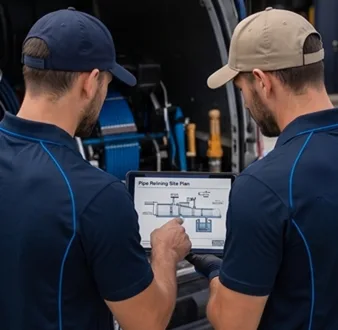
The most expensive time to discover a failing sewer is after new tiling has gone down. The second most expensive is after the slab for an extension has been poured over it.
A camera run costs a fraction of either and takes an hour. If you are getting quotes for a renovation on a house of this age, book it in the same fortnight. Where relining is needed it is far cheaper before the works than after.
A crack that opens in summer and closes in winter produces a fault that comes and goes, which is maddening to diagnose and very easy to dismiss as bad luck.
Western Sydney’s expansive clays swell and shrink with the seasons, cracking rigid old pipes and opening joints that snag waste.
A liner is continuous through the affected length, so seasonal movement no longer has a joint to work on. On reactive ground that is the difference between a repair that lasts and one that reappears the next dry summer.
This is the honest limit of the method. A liner follows the pipe it is cured inside. If the run has sagged into a belly or lost its fall, relining seals it and leaves the shape exactly as it was, so the water still pools where it pooled before.
Doonside is a post-war railway suburb in Western Sydney (postcode 2767), bordered by Blacktown, Woodcroft, Rooty Hill and the Eastern Creek corridor. Older clay sewers under its fibro and brick homes, plus mature street trees, make blocked drains one of the suburb’s most frequent plumbing problems.
On sloping ground that failure mode is common enough to check for specifically. Where the profile is wrong, the correct answer is excavation and re-lay of that section, and we will tell you so even though it is the more expensive quote.
On a clay line the barrel is usually fine. What has gone is the mortar or rubber ring at each joint, and there is one every few hundred millimetres, which is a great many small openings after sixty or eighty years in the ground.
Mature gums and brush box along Doonside’s older streets drive roots into 1950s-era clay pipe joints, matting into blockages that jetting alone only postpones.
That matters for the quote. You are not replacing a pipe, you are sealing a long series of joints, and a liner does the whole run at once rather than patching them one at a time.
Once is weather. Twice is a defect, and the second event is the point at which paying for a camera saves money rather than costing it.
What we are looking for is specific: a belly holding water, a joint that has opened, a section crushed by a vehicle crossing. Each has a different answer, and only one of them is relining. Knowing which you have is worth more than another clear.
Properties on a slope often have long drainage runs, sometimes crossing the whole block to reach the main. The practical questions are where the inspection openings are and whether the liner can be drawn through in one length or needs a second access.
That is worth establishing before quoting. A single long run costs less per metre than the same distance broken into stages, and the difference is decided by access, not by the pipe.
A recorded camera run with distances marked. Yours to keep, and usually credited if the work goes ahead.
The prevailing 2026 Sydney range for residential sewer relining.
Proportionate for one fault in a sound run. We will recommend it over a full liner when that is what the camera shows.
For a run failing along its length, which on old clay is the common finding.
Plus reinstatement. On a bare lawn it can win. Under anything you would miss, it usually does not.
Figures reflect the 2026 Sydney market rather than a quote. You get your own number once we have seen inside the pipe. Figures here are indicative of the 2026 Sydney market rather than a quote from us, you get your own number as a fixed price before any work starts.

A CCTV survey establishes the material, the diameter, where the defects are and how far they sit from the access. You see the footage, and it is what the quote is built from.
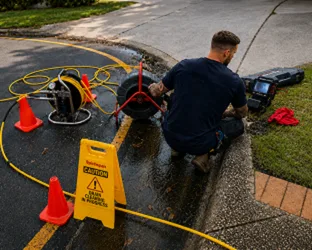
Patch or full length, and occasionally excavation instead. We will tell you when digging is the better answer even though it is the bigger quote.
The run is jetted so the liner bonds to pipe rather than debris, the liner is installed through the existing access, and it cures in place. Most domestic jobs are a single day.

Every branch the liner passed is reopened from inside, then the run is cameraed again so you can see it is continuous and the junctions are clear.
Send it through and we will come back with what it is likely to be, what the survey costs, and whether relining is even the right conversation.
Cost, lifespan, method, and the cases where a liner is the wrong answer.

Phone is quickest. The form reaches the crew covering Doonside, and the first step is always the survey.

Leave your details and our local Doonside team will call you back fast.